TADAAKI KUWAYAMA (b. 1932, Nagoya; d. 2023, New York) was born in Nagoya, Japan, and studied Japanese painting at the Tokyo University of the Arts before relocating to New York with his wife, artist Rakuko Naito, in 1958. Dissatisfied with both the traditional nihonga system and the contemporary Japanese art scene, Kuwayama developed a radically reductive visual language that helped define the emerging Minimalist movement. Following his 1961 solo exhibition at Richard Bellamy’s influential Green Gallery, he began producing monochromatic geometric paintings that rejected gestural abstraction in favor of what he described as “pure abstract” painting. Donald Judd was an early champion of his work and recognized his significant contribution to the development of Minimalism.
Throughout his career, Kuwayama continually refined his practice through evolving materials and spatial investigations, moving from Japanese mineral pigments and acrylics in the 1960s to metallic paints in the 1970s, oils in the 1980s, and, from the 1990s onward, works that engaged space itself as a primary medium. His art is distinguished by its absence of subjective expression and its emphasis on perception and immersive experience. Kuwayama was the subject of numerous solo and group exhibitions internationally, and his work is held in major museum collections including the Museum of Modern Art, the Metropolitan Museum of Art, and the Solomon R. Guggenheim Museum in New York, as well as the Buffalo AKG Art Museum, Yale University Art Museum, the National Museum of Modern Art, Tokyo, the National Museum of Art, Osaka, and the 21st Century Museum of Contemporary Art, Kanazawa.
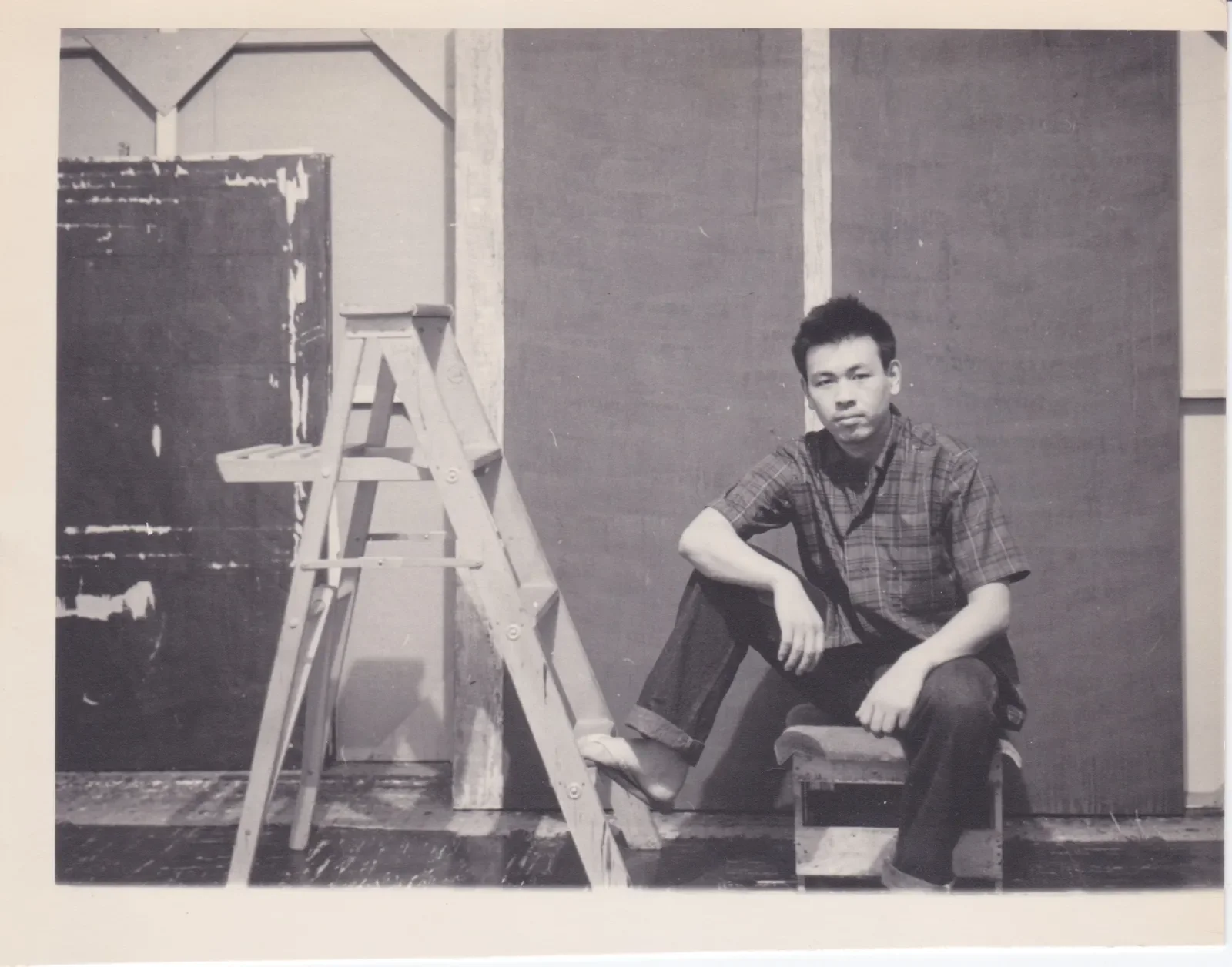
Tadaaki Kuwayama in his studio.