TAMIKO KAWATA (b. Kobe, Japan, 1936) came of age in postwar Japan, where a rejection of traditional gender roles and social hierarchies became central to both her life and artistic practice. She studied sculpture at the Tokyo University of Education (now the University of Tsukuba), embracing Bauhaus principles and avant-garde aesthetics that diverged from the dominant artistic trends of the period. After graduating in 1959, Kawata became the first female designer at Kagami Crystal Glass Works in Tokyo, where she achieved remarkable professional success before immigrating to the United States in 1961 and settling in New York the following year. Alongside a career as a designer of jewelry and modernist objects, she studied metalwork with Danish silversmith Adda Husted-Andersen and later taught metal fabrication and sculpture at the Craft Students League and the 92nd Street Y for more than three decades.
Kawata’s work is deeply informed by her experience as a Japanese immigrant and her engagement with everyday materials. Beginning with a wearable safety-pin jewelry collection featured in The New York Times in 1973, she transformed the humble fastener into the foundation of an expansive sculptural practice. Through intricate chains, woven grids, and organic forms inspired by natural structures, Kawata elevates an object associated with domestic labor into a powerful artistic medium. Her sculptures engage questions of identity, craft, and materiality while drawing connections to artists such as Ruth Asawa, Agnes Martin, and Sol LeWitt. Kawata’s work has been exhibited widely and is held in numerous public collections, including the Museum of Arts and Design, New York; the Montreal Museum of Fine Arts; the Honolulu Museum of Art; LongHouse Reserve, East Hampton; and the Lafcadio Hearn Memorial Museum, Matsue, Japan.
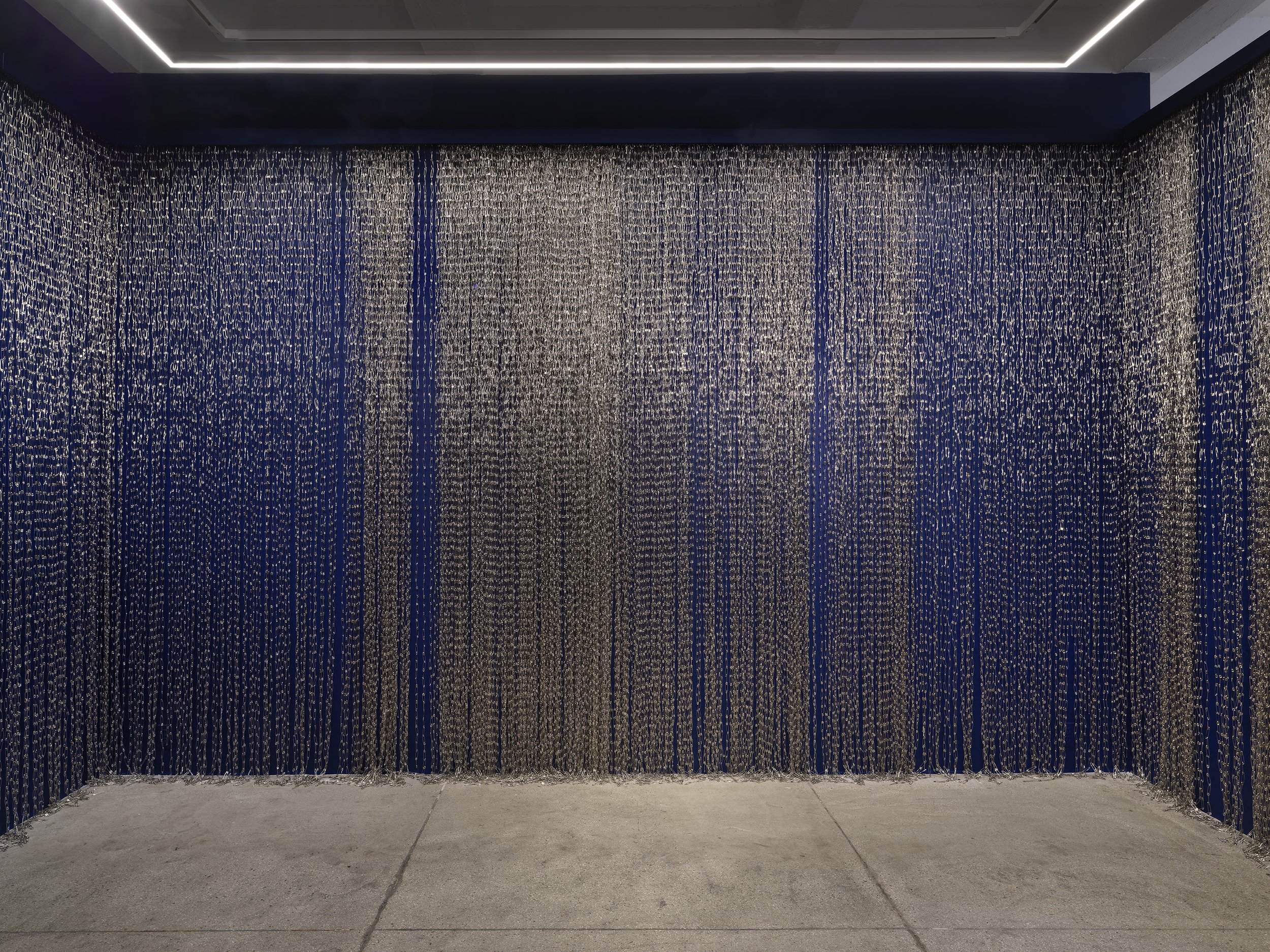
Installation view, TAMIKO KAWATA : Together II (Waterfall).