RAKUKO NAITO (b. Tokyo, Japan, 1935) graduated from the Tokyo University of the Arts in 1958, where she studied nihonga painting, before relocating to New York with her husband, artist Tadaaki Kuwayama. Seeking alternatives to conventional artistic methods, she briefly attended the Art Students League and began experimenting with optical art, spray paint, masking tape, and acrylics—then a relatively new medium introduced to her by Sam Francis. By the mid-1960s, Naito had developed a highly reductive visual language characterized by flat monochromatic color, simple geometric forms, and an emphasis on surface and materiality. Rejecting narrative and overt expression, her work has consistently explored repetition, structure, and perception through a rigorous process of formal experimentation.
Situated between drawing and sculpture, her tactile works merge traditional materials with a distinctly contemporary sensibility. Naito’s work has been exhibited internationally, including at White Cube; Mies van der Rohe Haus, Berlin; Museo Nacional Centro de Arte Reina Sofía, Madrid; and the Columbus Museum of Art, among others. Her work is held in numerous public collections, including the San Francisco Museum of Modern Art, the Aldrich Contemporary Art Museum, the Davis Museum at Wellesley College, and the Museo de Arte Contemporáneo in Buenos Aires. Naito lives and works in New York and was an artist-in-residence at the Josef and Anni Albers Foundation in 2003.
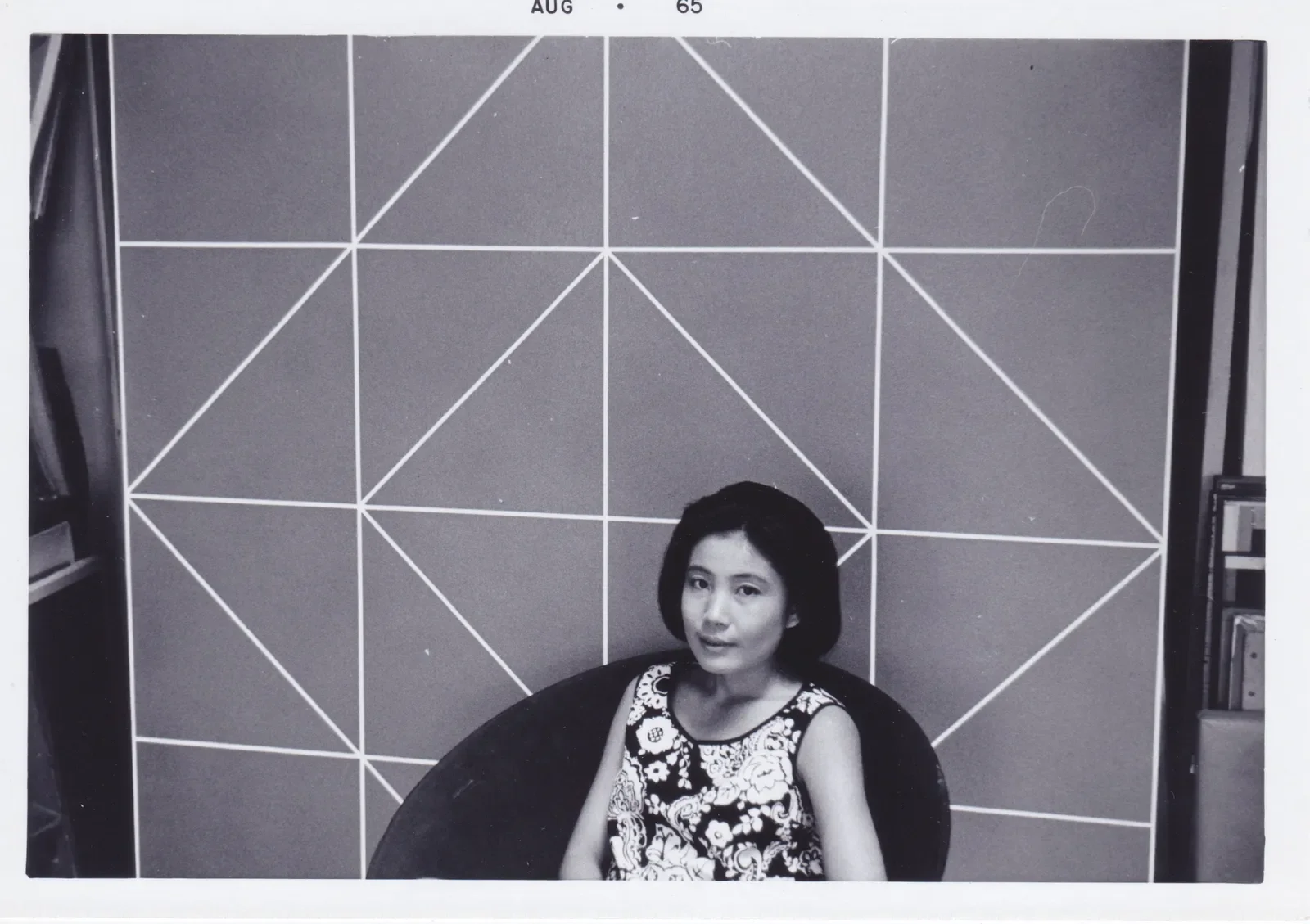
Rakuko Naito.