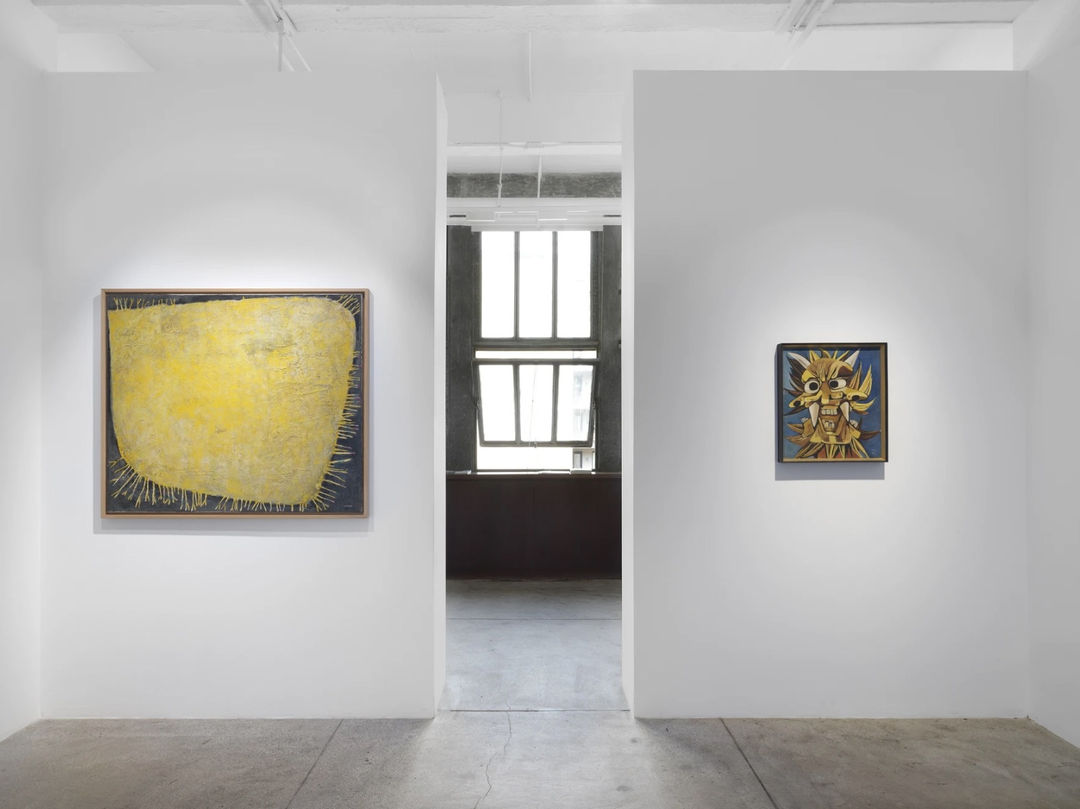
Yuki Katsura (1913-1991) forged a singular artistic path over a six-decade career, consistently resisting alignment with any single aesthetic movement. Although still underrecognized in Western art histories, she has long been acknowledged in Japan as a pioneering and critically acclaimed figure, emerging as a rare female presence at the center of the pre- and postwar avant-garde. Rising to prominence before World War II and remaining influential in its aftermath, Katsura pursued an autonomous modernist language that fused abstraction and representation, often reworking Japanese folklore and social conventions through satirical, intellectually rigorous compositions. Her work expanded the possibilities of Japanese painting while challenging the gendered constraints of a male-dominated art world.
Raised in Tokyo in a family that valued independence yet upheld traditional gender roles, Katsura's early training reflected the contradictions she would later contest. Initially steered toward nihonga as a "suitable" pursuit for women, she later studied oil painting but resisted expectations to confine herself to feminine subject matter. Her career accelerated in the 1930s when she joined avant-garde circles that embraced European abstraction and Surrealism, leading her to experiment boldly with unconventional materials such as fabric, rope, leaves, and collage. These innovations established her reputation as a radical modernist, and she became a central participant in key prewar avant-garde groups while subtly resisting wartime ideological pressures through allegorical and folkloric imagery.
After the war, Katsura deepened her political engagement, addressing women's rights, nationalism, and social change through caricature and allegory, while also playing a vital institutional role in rebuilding Japan's avant-garde networks. In 1956 she left Japan for Paris and New York, seeking to escape institutional comfort and reassert her independence; there, she exhibited internationally, absorbed new influences, and entered global avant-garde circles. Returning to Japan in 1961, she continued to exhibit widely, publish memoirs, and produce socially confrontational work well into her later years. Katsura's career ultimately challenges the notion of a rupture between pre- and postwar Japanese art, instead revealing a powerful continuity of modernist experimentation shaped by resilience, critique, and autonomy.