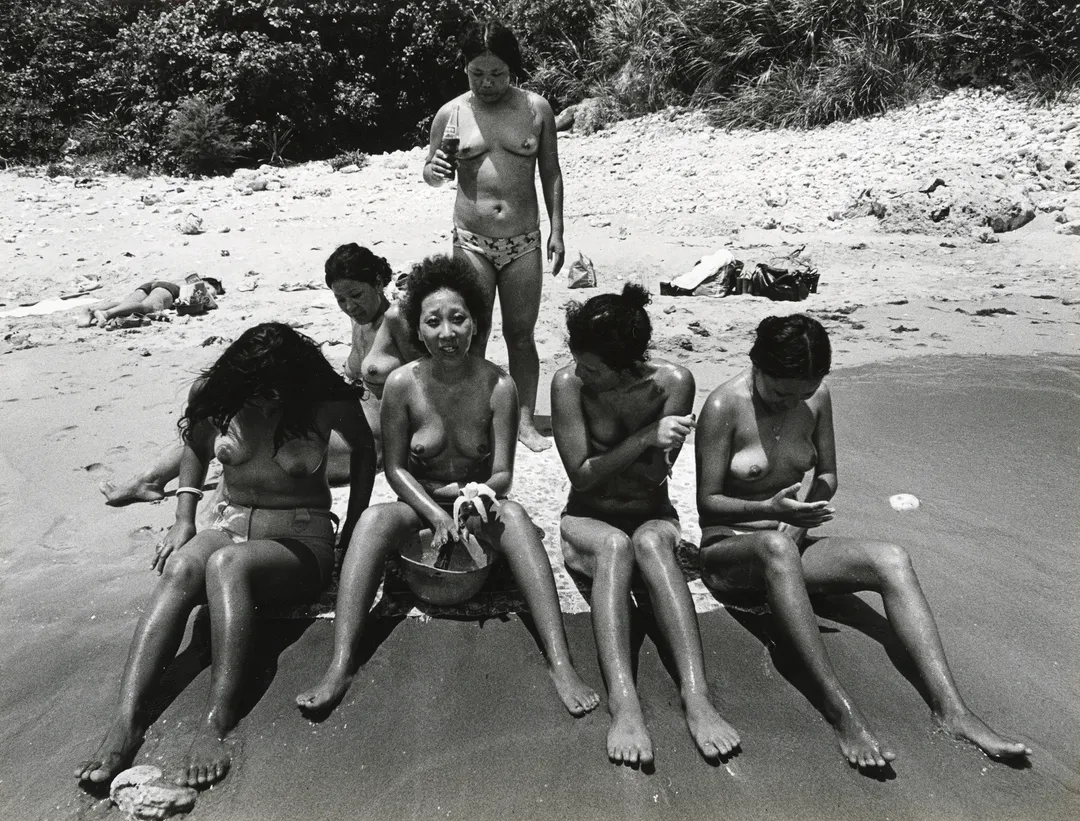
“Human beings have an ugly face and a beautiful face. They tell you lies, and they tell you truth. They are sweet, and they are violent. All of these things make a person. I want to see everything. Therefore, I always take photos of people standing right in front of them. I never hide myself when I take photos.” – Mao Ishikawa
Alison Bradley Projects is pleased to present Mao Ishikawa: ROGUE, the Okinawan photographer’s first solo exhibition in the United States, bringing together over 30 vintage prints from four of her major series: Red Flower (Akabanaa) (1975–1977), Life in Philly (1986), A Port Town Elegy (1983–1986), and My Family (2001–2005). Spanning three decades, the exhibition highlights Ishikawa’s distinctive approach to photography—one grounded in closeness, participation, and long-term relationships with her subjects. The exhibition opens on April 16th, 2026, with a reception from 6:00–8:00 p.m., and remains on view through June 6th, 2026.
Ishikawa’s early work emerged in the aftermath of Okinawa’s 1972 reversion to Japan, a moment that left intact the extensive network of U.S. military bases on the island. Produced in Koza City and Kin Town, Red Flower centers on the social worlds surrounding Camp Hansen, where Okinawan women working in bars formed relationships with African American U.S. servicemen. Rather than adopting a distanced or explanatory framework, Ishikawa embedded herself in these environments, working alongside her subjects and photographing the rhythms of daily life: late nights, shared interiors, and moments of collective ease.
Her approach collapses the boundary between observer and participant. The resulting images function as both document and personal record, shaped by relationships built over time. Rather than reducing Okinawa to a narrative of occupation, Ishikawa foregrounds a complex network of connection, care, and mutual recognition formed within these conditions. This relational method extends into Life in Philly, produced during her time in Philadelphia, visiting a former serviceman, Myron Carr, whom she had met in Okinawa. There, her attention shifts to scenes of domestic and communal life, capturing moments of revelry and friendship, intimacy and love, and everyday movement through the city, tracing continuities between lives shaped across different geographies.
In A Port Town Elegy, Ishikawa turns to another marginal community in Naha, photographing port workers and day laborers she came to know through her own bar. The series continues her long-term, immersive approach, capturing a social world defined by both precarity and community. Later, in My Family, Ishikawa directs the camera toward herself. Produced following major surgeries, these self-portraits extend her practice inward, confronting the body with the same directness and refusal of distance that defines her earlier work.
Across her practice, Ishikawa resists fixed narratives, insisting instead on the density of lived experience within conditions of militarization, marginalization, and historical entanglement. Her photographs remain attentive to the ways relationships—however fragile or fleeting—take shape within these structures.
Ishikawa is currently included in the Whitney Biennial 2026, marking a significant moment of recognition in the United States. Seen in this context, her work articulates a perspective shaped from within Okinawa’s ongoing geopolitical position—one that continues to resonate across generations and borders.
The exhibition is accompanied by an original essay by Eimi Tagore titled "Without Exception."
